Rejog Stash: Your Stuff, Findable and Lendable
Published by Dan Richardson at https://freepdx.com/deep-dives/rejog-stash
- Team
- Solo
- My contribution
- Owner and principal engineer
- Outcome
- The iPhone app, borrower web experience, and backend are live. The Android app is built and working, and is still waiting for Play Store approval.
- Status
- Production: iPhone and web live; Android awaiting Play Store approval
- Constraints
- Native iOS, native Android, and web each have their own codebase and use the same versioned API.
- Borrower privacy is enforced through separate storage and server-side trust boundaries.
- Android store release remains outside the shipped iPhone, web, and backend path.
Rejog Stash went from a napkin sketch to live on the App Store in 6 weeks. The complete codebase includes 2 mobile apps (Swift on iOS, Kotlin on Android), a web app, and a Cloudflare backend - including a complete moderation module that was not in the original plan! I built it solo while working on three other projects.
In building Stash, I had two goals:
- Use Latticeflow to create an application - agentic from start to finish - that solves a real problem
- Push the process hard enough to find where it breaks, so I could learn and improve it
I also wanted code I could show instead of describe. Most of what I have built is owned by someone else and sits behind an NDA. I built Stash with Latticeflow, my agentic development process, and throughline-build (Build) is my implementation of it. I created it so I could learn why they make the choices they do, and how to guide them. It’s written in C#/.NET, cross platform, and free as in air… or beer (I always get those 2 confused).
Rejog Stash was born
I’m obsessed with memory - not the silicon kind - but real, human, fallible, ephemeral memory. I have a hard time keeping track of things, and never remember who I lent it to. So why not write an app to catalog my stuff and help me remember?
With peer-to-peer lending. AI to identify things in photos. GPS to remember where it is. QR codes instead of accounts. Native iOS and Android and infrastructure. Latticeflow as the build process.
Tech Stack
- Swift
- Kotlin
- TypeScript
- JavaScript
- HTML/CSS
- SQL
- Python
- iOS SwiftUI
- Android Jetpack Compose/AndroidX
- Cloudflare Workers
- static browser frontend
- CameraX
- iOS SwiftData + CloudKit/private DB + Keychain/iCloud Keychain
- Android Room/SQLite + DataStore/EncryptedSharedPreferences
- Cloudflare D1/KV/R2
- XcodeGen/TestFlight/App Store Connect scripts
- Gradle/R8/Firebase App Distribution/Play tracks
- Wrangler/Workers Assets/custom domains
- D1 migrations
- iOS Vision/Core ML MobileCLIP/FoundationModels/OpenRouter relay
- Android ML Kit/ONNX Runtime Mobile/MobileCLIP model download
- Worker api-router relay to OpenRouter
- XCTest/XCUITest
- Android JUnit/Robolectric/Compose UI tests/MockWebServer
- Vitest/node:sqlite
- Playwright
- Python device integration harnesses
- StoreKit 2
- Play Billing
- APNs/FCM/Web Push
- Resend
- osmdroid
- Retrofit/OkHttp/kotlinx.serialization
- Coil
- ZXing
How It Works
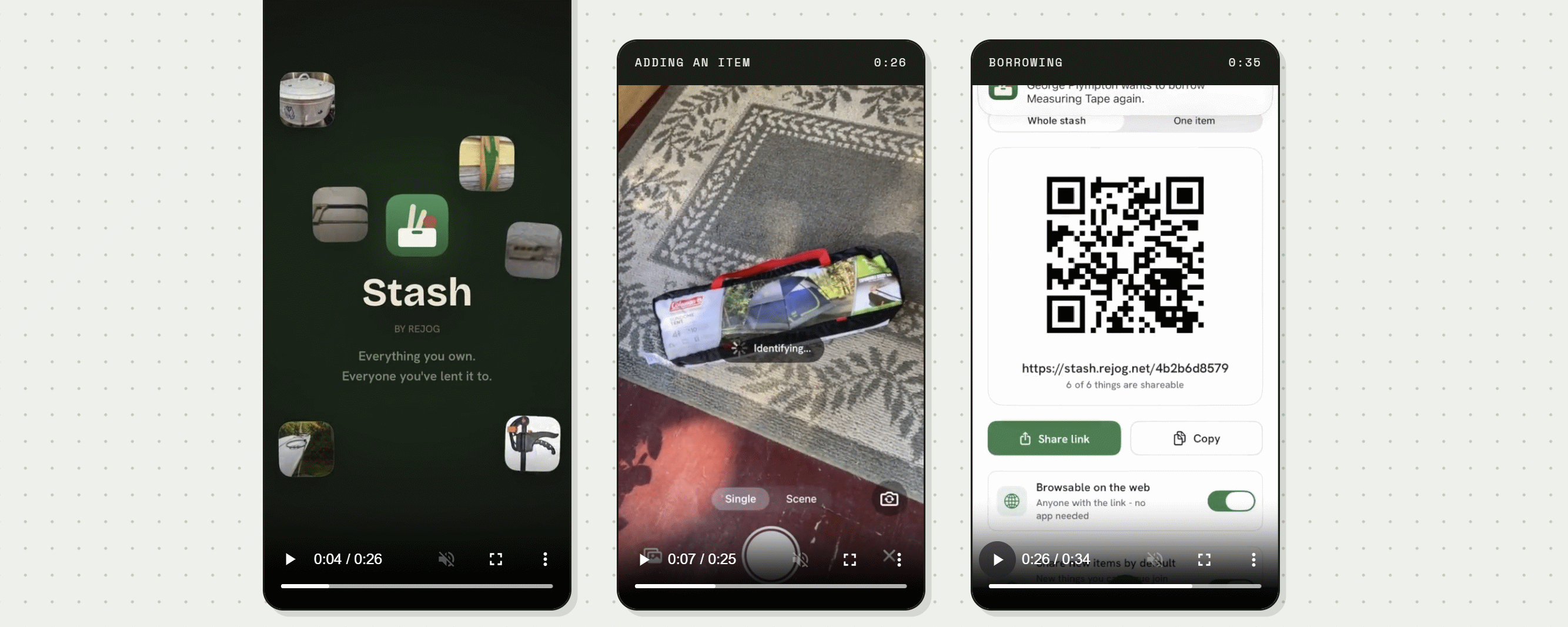
Tap the camera button and take a photo. Vision detects objects, sends them through an owner-authenticated relay to be identified. iOS 27 will bring on-device AI so identification stays on the phone - and it’s pretty good! There’s a local fallback if you want to stay offline, too. That’s how the catalog is built - you shouldn’t have to enter text or ids unless you want to.
To search, you type in a word that becomes a needle query into curated haystack that includes OCR text pulled off the photo. A book’s ISBN is searchable and you didn’t have type it in.
Want to lend somebody a drill? Show them a QR code or send them a link. They don’t need an account - that link you sent them is like a one-time key to a storage locker.
Rejog Stash architecture. Privacy is enforced in the code, not in a policy. Location is only needed at the moment of capture - never in the background. Contact details are only sent to remember the loan.
Two Planes, Built While Flying
The prudent approach would have been to build one platform, stabilize it, then port. I could have taken the time and done that. But I wanted to see where the process broke, and building two native clients at once is a good way to find out. I did it deliberately.
iOS and Android were built in parallel. iOS was the lead platform for design and features. Android ported a feature from iOS as soon as it was committed, but implemented with native Android patterns. Two planes built while flying, one taking cues from the other mid-air.
I also decided I needed a web app, so… three planes. 😅
The Wire Contract
That only works if the thing holding them together is rigid. The codebases don’t share a model layer, but I gave the agents structure - an API, a strict rule on how to change it, and a requirement to be good communicators. They called it The Wire Contract. Sure.
Infrastructure owns the API. It’s additive only, so changes don’t break shipped apps. The app agents file change request tickets, and implement their side on approval.
build also installs a cross-impact skill. It requires agents to ponder one question: did what you just implement materially affect another project? If so, file a ticket there so it can react. Each repo’s .build/conductor.toml names its siblings and the file that owns the contract, so nobody is guessing. If the check cannot run, the instruction is to stop, not improvise.
This isn’t new. It’s just standard processes that most Agile teams use every day. I found out how much more it mattered in Agentic development. With a single human-on-the-loop - human context management is critical. The only thing that keeps the agents from drifting when you’re moving this fast is strict boundaries. Otherwise things go off the rails.
What Made It Hard
Some technical things were tough - fast, on-device object identification for one. But building three clients, in parallel, by myself, without breaking things or drifting? That was hard.
Validation and QA was a challenge, but it was as automated as I could make it. Agents use a harness to debug on-device. I have 1,300 test cases, and reviewer agents require screenshots to verify AC. And I built a physical rig four phones (iPhones and Android), through the live lend-borrow cycle.
Where It Bent
I wanted to know how far this could be pushed, and oh-boy I found out. 6 weeks of continuous human work - bye-bye Summer, hello Fall! - was the cost. It was real calendar time, and even with agents, it was still an enormous amount of work. Agents don’t sleep, and I didn’t get much either.
That came at a cost, but this was an experiment. I allowed myself to make decisions I normally wouldn’t. I was the stakeholder, reviewer, and the only user who mattered. I decided when to ship. If this were any other project, there would be a change-approval path, sprint reviews, real QA, and an independent security review I didn’t write myself. More human hands, eyes, and brains.
The education was very valuable, and I’ll never do it again.
Scope. Stash crept, badly, and I let it. Claude and I added some cool features. But that moderation module? It was never in the plan. Google required it because sometimes a photo labeled Sawzall is not what it appears to be. Humans, the Internet, and Why We Can’t Have Nice Things. Some creep was me learning how to manage the Agents. Figuring out the right mix of words and controls is what Agentic development is all about
But it did ship. The process worked. 1173 tickets moved across the board in 6 weeks. And the code is good.
The Throughline
I want to create software that makes the world better. Software is personal, and everything I build starts with someone I want to help. Stash is one slice of Rejog, shipped early and built primarily for me - to learn if the Latticeflow process would work in the real world. It did.
The hard parts - managing the API across three clients, vision running on the phone, privacy enforced in code instead of in a promise - are all reusable. Rejog is working it’s way through development, more on that after I check out this thing called The Sun. 🌞
The throughline, however, is done.
Status
The iPhone app is live on the App Store. The borrower web app and backend are live at stash.rejog.net. The Android app is built and working, and in the Play Store queue.
Rejog is the product brand. Rejog Stash is built by Throughline Tech, LLC and distributed on the App Store by FreePDX.